
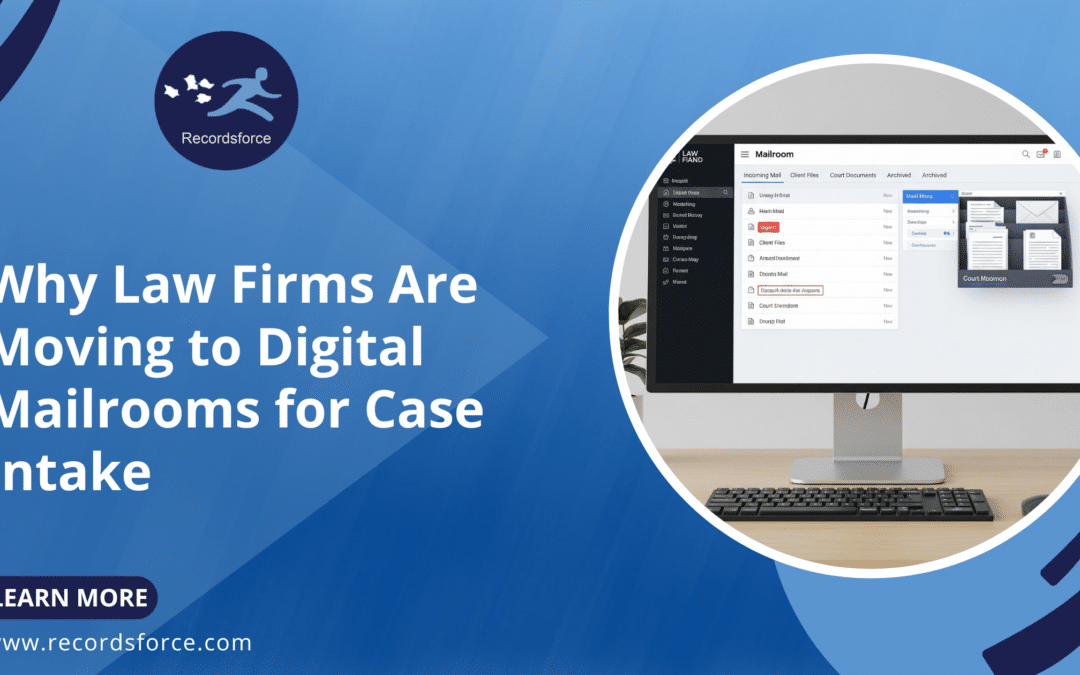
Law firms manage enormous volumes of incoming documents every day. Legal notices, court filings, contracts, medical records, client correspondence, discovery documents, invoices, and case-related communications arrive through physical mail, email, secure portals, and digital attachments.
For many firms, handling this intake process manually has become increasingly unsustainable.
As legal operations grow more document-intensive and client expectations continue to rise, law firms are turning to digital mailrooms and mail intake automation to modernize case intake workflows, improve efficiency, and reduce administrative risk.
What Is a Digital Mailroom for Law Firms?
A digital mailroom is a centralized outsourced service that captures, classifies, indexes, validates, and routes inbound legal documents into the appropriate case management systems, workflows, or personnel.
Instead of relying on manual mail sorting, scanning, data entry, and distribution, a digital mailroom automates the intake process while maintaining visibility, security, and compliance.
For law firms, this means incoming case documents can be processed faster, routed more accurately, and made immediately accessible to attorneys, paralegals, and support teams.
Why Traditional Legal Mail Intake Is No Longer Sustainable
Many law firms still rely on highly manual processes to manage incoming documents. Physical mail is opened and sorted by administrative staff, scanned into systems, manually named, indexed, and forwarded to legal teams.
This creates several operational challenges.
Delayed Case Processing
Manual intake slows down the speed at which documents reach attorneys and case teams. Delays in routing can impact response times, filing deadlines, and client communication.
High Administrative Burden
Legal staff often spend hours reviewing, sorting, renaming, and organizing documents rather than focusing on billable or strategic work.
Increased Risk of Errors
Manual document handling increases the likelihood of:
- Misfiled records
- Incorrect case assignment
- Missing documents
- Incomplete indexing
- Lost deadlines
Even small intake errors can create serious legal and compliance consequences.
Limited Visibility
Traditional mail handling provides little transparency into where documents are in the intake process, who has reviewed them, or whether they were properly routed.
Scalability Problems
As firms grow and case volumes increase, manual intake processes become difficult to sustain without adding significant staffing costs.
How Digital Mailrooms Improve Legal Case Intake
Digital mailrooms automate and standardize the intake lifecycle from document receipt through case distribution.
Automated Document Capture
Incoming mail, scanned files, email attachments, and digital submissions are securely captured into a centralized workflow.
Intelligent Classification
Documents are automatically categorized based on document type, case number, client information, practice area, or predefined business rules.
For example, systems can identify:
- Court filings
- Client intake forms
- Medical records
- Contracts
- Discovery documents
- Settlement correspondence
Data Extraction and Indexing
Key information is extracted and indexed so documents become searchable and immediately usable inside legal systems.
Common extracted fields may include:
- Client names
- Case numbers
- Filing dates
- Matter IDs
- Opposing counsel
- Court jurisdictions
Quality Validation
Advanced mail intake automation solutions combine intelligent processing with human validation to ensure accuracy and reduce intake exceptions.
This is especially important for legal organizations where document precision directly affects compliance and case outcomes.
Automated Routing
Once processed, documents are automatically routed to the appropriate:
- Attorney
- Practice group
- Case management system
- Litigation support team
- Records repository
- Workflow queue
This dramatically reduces delays and administrative overhead.
Benefits of Digital Mailrooms for Law Firms
Faster Case Intake
Digital mailrooms accelerate the speed at which documents are reviewed, indexed, and delivered to legal teams.
Attorneys gain quicker access to critical information, improving responsiveness and case progression.
Improved Client Service
Clients increasingly expect fast communication and efficient handling of legal matters. Faster intake workflows help firms respond more quickly to inquiries, filings, and case developments.
Better Compliance and Auditability
Law firms must maintain strict document governance and chain-of-custody procedures.
Digital mailrooms create:
- Audit trails
- Processing logs
- Standardized workflows
- Access controls
- Secure document handling
This strengthens compliance and reduces operational risk.
Reduced Administrative Costs
Automating repetitive intake tasks reduces the amount of manual labor required to process inbound documents.
Firms can improve productivity without proportionally increasing headcount.
Enhanced Searchability and Retrieval
Indexed legal documents become easier to locate and retrieve, helping attorneys access case information faster.
Greater Operational Visibility
Managers gain insight into:
- Intake volumes
- Processing times
- Workflow bottlenecks
- Document status
- Routing accuracy
This supports continuous operational improvement.
Real-World Example: Digital Mailroom Success for a Disability Benefits Law Firm
The value of a digital mailroom becomes even clearer when applied in a real legal environment.
A disability benefits law firm was struggling with the challenges that many growing legal organizations face: high volumes of incoming mail, labor-intensive document handling, and delays in getting critical information to legal staff. Thousands of documents related to active client matters were arriving through traditional mail channels, creating administrative bottlenecks and increasing the burden on internal teams.
To improve efficiency, the firm partnered with Recordsforce to implement a digital mailroom solution for legal offices. Incoming mail was securely received, opened, digitized, indexed, and delivered electronically to the appropriate personnel. Rather than relying on manual sorting and distribution, documents were processed through a structured workflow designed to accelerate access while maintaining security and accountability.
As a result, the firm significantly reduced the time spent handling physical mail, improved document accessibility for attorneys and support staff, and established a more scalable process for managing growing document volumes. Legal teams gained faster access to case-related correspondence, helping them respond more efficiently while maintaining strong records management practices.
This case demonstrates how digital mailroom services can help law firms eliminate paper-based bottlenecks, improve operational efficiency, and create a more streamlined intake process for critical legal documents.
Read the full case study: Digital Mailroom Law Office Case Study.
Why Hybrid Automation Matters in Legal Intake
Many organizations assume AI alone can solve document intake challenges. However, legal document processing often involves:
- Complex formats
- Handwritten notes
- Changing court forms
- Case-specific workflows
- Sensitive compliance requirements
Fully autonomous systems may struggle with consistency and accuracy in high-risk legal environments.
That is why many law firms prefer a hybrid approach that combines intelligent automation with structured human quality review.
This model helps ensure:
- Accurate classification
- Reliable indexing
- Proper routing
- Reduced exceptions
- Stronger compliance controls
Common Legal Documents Processed Through Digital Mailrooms
Law firms use digital mailrooms to process a wide range of inbound records, including:
- Court filings
- Complaints and petitions
- Discovery materials
- Medical records
- Client intake packets
- Contracts and agreements
- Settlement documents
- Billing correspondence
- Regulatory notices
- Insurance documentation
- Litigation support records
Digital Mailrooms and Legal Digital Transformation
The legal industry is undergoing rapid digital transformation. Remote work, growing data volumes, and rising client expectations are forcing firms to modernize operational workflows.
Digital mailrooms play a foundational role in this transformation by:
- Eliminating paper bottlenecks
- Accelerating document availability
- Improving operational scalability
- Supporting hybrid legal teams
- Integrating with legal technology ecosystems
For firms pursuing long-term operational efficiency, digital mailrooms are increasingly becoming a strategic necessity rather than an optional upgrade.
Choosing the Right Digital Mailroom Solution for Legal Intake
When evaluating digital mailroom solutions, law firms should look for:
- Legal workflow expertise
- Secure document handling
- Compliance-focused processing
- Human quality validation
- Integration with case management systems
- Scalable intake operations
- Audit and reporting capabilities
Solutions designed specifically for enterprise document workflows often provide greater reliability and long-term operational support than generic automation platforms.
The Future of Legal Case Intake
As document volumes continue to increase, law firms can no longer rely on manual intake workflows to support modern legal operations.
Digital mailrooms help firms process inbound legal documents faster, more accurately, and with greater visibility. By automating classification, indexing, validation, and routing, firms can reduce administrative burdens while improving case responsiveness and operational control.
For legal organizations focused on scalability, compliance, and client experience, digital mailrooms are becoming an essential part of the modern legal technology stack.