
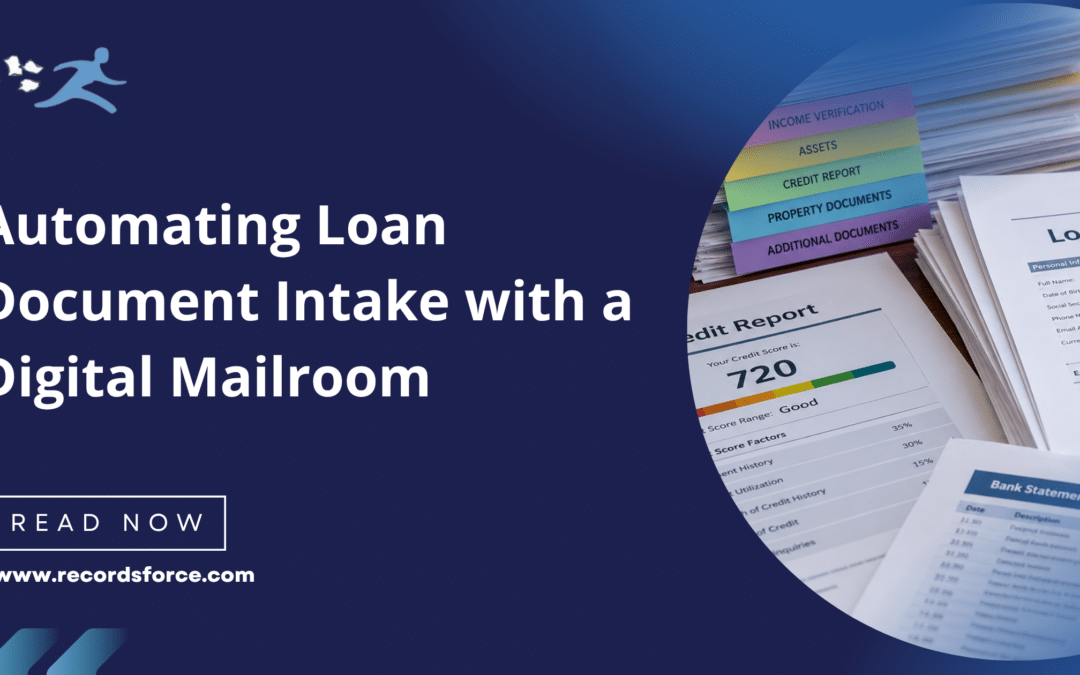
Loan processing depends on documents. Applications, income verification, bank statements, tax forms, appraisals, insurance documents and signed agreements all contain information lenders need to move a loan forward.
The challenge is that those documents don’t always arrive in one place or one format.
Borrowers, third parties and internal teams may submit information through physical mail, email, attachments, fax and other channels. Employees then have to identify each document, determine which loan it belongs to, capture relevant information and route it to the right person or system.
A digital mailroom can automate loan document intake, creating a centralized process for receiving, digitizing, classifying, extracting and routing incoming lending documents.
Instead of employees spending time sorting documents and manually entering data, lenders can move information into their loan workflows faster and more consistently.
What Is Automated Loan Document Intake?
Automated loan document intake is the process of capturing incoming loan-related documents and using technology to identify, process and route them with less manual intervention.
A digital mailroom for banking or finance can act as the front end of this process.
Documents arriving through multiple channels are brought into a standardized workflow where they can be:
- Received and digitized
- Classified by document type
- Matched with relevant borrower or loan information
- Processed using intelligent document processing/data extraction
- Validated for accuracy
- Delivered to the appropriate system or employee
This creates a more consistent path between document received and document ready for use.
What Loan Documents Can a Digital Mailroom Process?
Loan workflows can involve dozens of document types depending on the lender and type of financing.
A digital mailroom can process documents such as:
- Loan applications
- Bank statements
- Pay stubs
- W-2 forms
- Tax documents
- Income verification
- Employment verification
- Identification documents
- Credit-related documentation
- Property appraisals
- Purchase agreements
- Insurance documents
- Mortgage documents
- Disclosures
- Signed agreements
- Titles
- Deeds
- Correspondence
- Checks and payments
- Supporting borrower documentation
The exact workflow can be configured around the document types and information required by the lender.
How Does a Digital Mailroom Automate Loan Document Processing?
Automation begins as soon as a document enters the organization.
1. Centralize Incoming Loan Documents
Loan documents may arrive through physical mail, email, email attachments, fax or other submission channels.
Without a centralized process, different teams may handle these documents differently. Some might be manually scanned, others downloaded from an inbox and others forwarded between employees.
A digital mailroom can bring these documents into a common intake process.
This creates greater consistency regardless of how a document originally arrived.
2. Digitize Physical Loan Documents
Paper documents are prepared and scanned into high-quality digital images.
Optical Character Recognition (OCR) can then convert information within scanned documents into machine-readable text.
Once documents are digital, they can move through automated workflows rather than relying on employees to physically distribute paperwork between departments or locations.
3. Automatically Classify Documents
The next challenge is determining what each document actually is.
Intelligent Document Processing (IDP) can use AI and document recognition technology to automatically classify incoming documents.
For example, a workflow might identify whether an incoming file is a bank statement, pay stub, tax form, appraisal or insurance document.
Once the document type is identified, the appropriate processing rules can be applied automatically.
4. Extract Important Loan Data
Classification tells the system what a document is. Data extraction identifies the information contained within it.
Depending on the document and workflow, a digital mailroom may capture information such as:
- Borrower name
- Loan or account number
- Property address
- Document type
- Document date
- Employer name
- Income information
- Financial institution
- Account information
- Payment amount
- Insurance information
- Other lender-defined fields
This information can then be used for indexing, routing and downstream processing.
Instead of an employee opening a document and manually entering the required fields, much of that work can be automated.
5. Validate Extracted Information
Loan documents don’t always follow consistent formats.
Bank statements vary by institution. Pay stubs differ by employer. Documents may be scanned poorly, handwritten or missing information.
For this reason, automated extraction should be paired with appropriate validation.
Documents or data that don’t meet predefined confidence thresholds can be flagged for human review. This allows lenders to automate routine documents while providing additional oversight when information requires verification.
6. Match Documents to the Correct Loan or Workflow
One of the most important parts of loan document intake is making sure information reaches the correct file.
Extracted borrower names, loan numbers, property addresses or other identifiers can be used to help associate incoming documents with the appropriate loan or account.
Business rules can then determine where the document needs to go next.
For example, a document could be routed based on its type, loan status, branch, department or other lender-defined criteria.
7. Deliver Documents and Data to Existing Systems
A digital mailroom shouldn’t become another isolated place employees need to check.
Processed documents and extracted data can be delivered to a document management system, loan origination system, servicing platform, secure cloud repository or other business application, depending on available integrations and workflow requirements.
The goal is to move usable information into the systems employees already rely on.
Why Automate Loan Document Intake?
Manual document intake can create a bottleneck before the actual lending work even begins.
An employee may need to open an envelope or email, determine which borrower it relates to, identify the document, rename the file, enter information, upload it to another system and notify someone that it has arrived.
Multiply those steps across hundreds or thousands of incoming documents and document intake becomes a significant administrative workload.
Mail intake automation can help lenders reduce that burden.
Faster Access to Loan Documents
Digitized documents can be made available to authorized employees without waiting for physical paperwork to move between offices or departments.
Less Manual Data Entry
OCR and Intelligent Document Processing can capture required information from incoming documents, reducing repetitive data entry.
More Consistent Document Routing
Predefined business rules can determine where documents should go rather than relying entirely on employees to manually route each item.
Better Document Visibility
Digital processing can create a record of when documents were received, processed and delivered, giving lenders greater visibility into incoming information.
Easier Support for Distributed Teams
Digital documents can be securely routed to authorized employees regardless of whether they work in the same office where the document was originally received.
Can a Digital Mailroom Process Email and Faxed Loan Documents?
Yes.
Although the term “mailroom” traditionally refers to physical mail, modern digital mailroom workflows can process documents from multiple channels.
Emails, email attachments and faxes can be incorporated alongside scanned physical documents.
This is particularly useful in lending environments where supporting documentation may arrive through several different channels.
Instead of maintaining separate workflows for paper, email and fax, lenders can apply consistent classification, extraction, validation and routing rules across incoming documents.
How Does Intelligent Document Processing Help Lenders?
Intelligent Document Processing goes beyond basic document scanning.
Traditional scanning creates a digital image. IDP helps determine what the document is and what information it contains.
For loan processing, this means technology can help recognize document types, extract important fields and prepare information for downstream workflows.
For example, rather than simply creating a PDF of a mailed bank statement, an IDP workflow could classify it as a bank statement, extract borrower information and other required fields, validate the results and route the document according to the lender’s business rules.
The document becomes actionable information rather than simply a digital image.
How Can Lenders Securely Process Loan Documents?
Loan documentation can contain sensitive personal and financial information, making security an important part of document intake.
Organizations should consider security throughout the complete document lifecycle, including:
- Secure mail receipt and transportation
- Document chain of custody
- Physical facility security
- Role-based access
- Encryption
- Audit trails
- Secure storage
- Secure data transmission
- Document retention and destruction procedures
- Business continuity and disaster recovery
When outsourcing loan document processing, lenders should evaluate how a provider protects information during both physical and digital stages of the workflow.
Should Loan Document Intake Be Outsourced?
Some lending organizations build and manage document intake operations internally, while others outsource all or part of the process.
Maintaining an in-house operation may require staff, scanners, software, quality assurance processes, physical space, security controls and ongoing workflow management.
A fully outsourced digital mailroom shifts much of that operational responsibility to a specialized provider.
The provider can receive and digitize physical documents, process incoming digital files, classify documents, extract information, perform validation and deliver finalized documents and data according to the lender’s requirements.
For organizations trying to automate document intake without adding additional internal infrastructure, outsourcing can provide another option.
How Recordsforce Automates Loan Document Intake
Recordsforce helps financial services organizations turn incoming documents into structured, usable information through fully outsourced digital mailroom and Intelligent Document Processing solutions.
Physical mail can be securely received, prepared and scanned, while emails, attachments and faxes can also be incorporated into automated workflows.
AI and automation are used to classify documents and extract required information, with human validation available when necessary to help ensure accuracy.
Finalized documents and data can then be delivered through Recordsforce Cloud or integrated with existing business systems using available integration methods.
This allows lending organizations to automate the repetitive work at the beginning of document processing while maintaining visibility and control over where information goes next.
Frequently Asked Questions About Loan Document Automation
What is loan document automation?
Loan document automation uses technologies such as OCR, AI and Intelligent Document Processing to reduce manual work involved in receiving, identifying, extracting data from and routing lending documents.
Can a digital mailroom process mortgage documents?
Yes. Digital mailroom workflows can be configured to process many mortgage-related documents, including applications, bank statements, income documentation, appraisals, insurance documents, disclosures, correspondence and other supporting documentation.
Can loan documents be automatically classified?
Yes. Intelligent Document Processing can identify different document types and apply workflow rules based on their classification.
Can a digital mailroom extract data from loan documents?
Yes. Data extraction can capture lender-defined information such as borrower names, loan numbers, property addresses, dates and other fields. The exact fields available depend on the document and workflow.
Does a digital mailroom replace a loan origination system?
No. A digital mailroom is typically used to improve the intake and processing of incoming documents. Processed documents and data can then be delivered to existing loan origination, document management or other business systems when appropriate integrations are available.
Can banks outsource loan document scanning and processing?
Yes. Banks and other lending organizations can outsource some or all of their document intake operations to providers that offer scanning, digital mailroom and document processing services. Organizations should evaluate security, compliance, integration and workflow requirements when selecting a provider.
Turn Incoming Loan Documents Into Actionable Data
A digital mailroom combines document capture, OCR, Intelligent Document Processing, data extraction, validation and automated routing to create a more streamlined intake workflow.
For lenders still relying on employees to manually sort mail, monitor inboxes, scan documents, enter data and route files, automating the front end of the process can remove a significant administrative bottleneck and help information move through lending workflows more efficiently.