
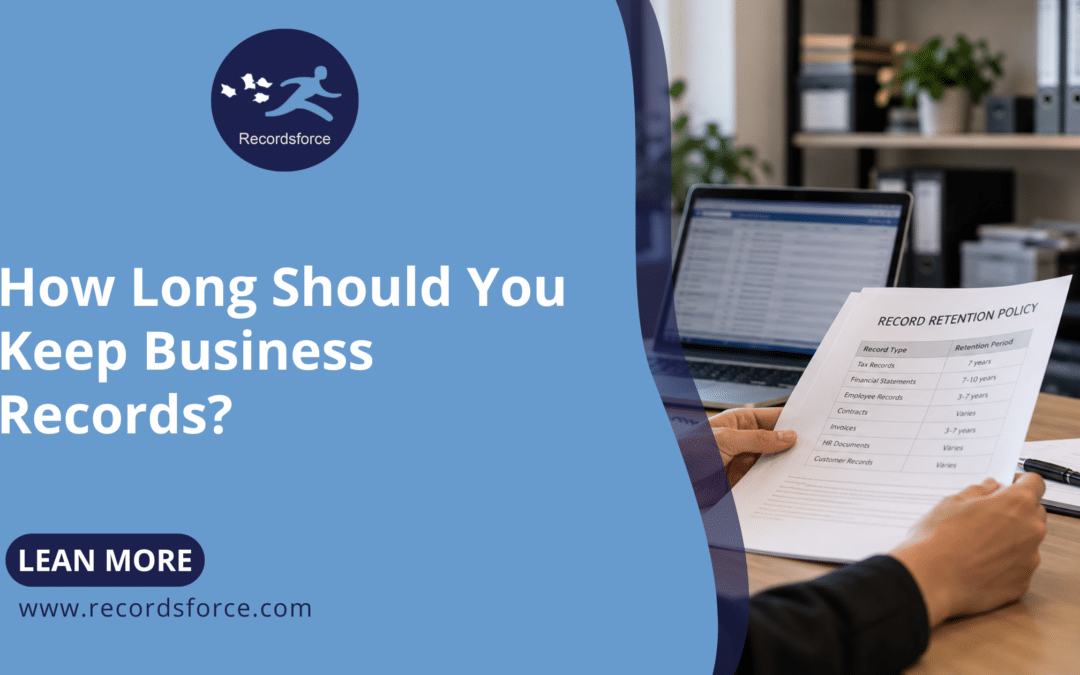
How long should a business keep its records? The answer depends on the type of document, applicable legal requirements, operational needs, and its long-term value to the organization.
For many businesses, determining how long to retain documents becomes a priority when storage rooms are overflowing, warehouses are filled with boxes, or the organization is preparing to digitize its paper records.
But before scanning everything or paying to store documents indefinitely, businesses should ask an important question: Do we actually need to keep all these records?
At Recordsforce, we frequently work with organizations that have accumulated years or even decades of paper documents. Often, the first step toward a more efficient document management strategy isn’t scanning. It’s understanding what records exist and how long they need to be retained.
To simplify this process, we use a framework called the FLOH Method, which evaluates records based on four factors: Financial, Legal, Operational, and Historical.
Watch: Bill Becker Explains How to Determine Records Retention Periods
In this episode of Ask Recordsforce, Bill Becker, President and Founder of Recordsforce, explains how businesses can determine how long to keep their records Bill discusses how organizations can evaluate their existing records, determine which documents need to be retained, and identify opportunities for document scanning or secure destruction.
What Is a Records Retention Policy?
A records retention policy is a set of guidelines that defines how long an organization must keep different types of business records and what should happen to those records when their retention periods expire.
An effective records retention policy helps organizations:
- Meet applicable legal and regulatory requirements.
- Reduce unnecessary physical and digital storage costs.
- Improve access to important business information.
- Identify documents eligible for secure destruction.
- Support audits, compliance reviews, and litigation readiness.
- Determine which paper records should be digitized.
Without a clear policy, organizations may retain documents longer than necessary, increasing storage costs and making information harder to locate.
Conversely, destroying records too early can create compliance issues, operational disruptions, and legal risks.
The goal is to establish a consistent, defensible approach to managing business records throughout their lifecycle.
What Is the FLOH Method for Record Retention?
The FLOH Method is a four-part framework used by Recordsforce to help businesses evaluate how long different records should be retained.
FLOH stands for:
- F – Financial: Is the record needed for financial transactions, reporting, or accounting?
- L – Legal: Is there a law, regulation, contractual obligation, or compliance requirement that determines how long the record must be kept?
- O – Operational: Is the record necessary for ongoing business operations?
- H – Historical: Does the record have long-term historical significance to the organization?
By applying these four considerations to each document category, businesses can develop more practical and consistent records retention schedules.
Importantly, these factors should be considered together. A document may have multiple retention requirements, and the organization should account for all applicable obligations before approving its destruction.
1. Financial: Do You Need the Record for Financial Reasons?
The first consideration in the FLOH Method is financial value.
Businesses generate numerous records related to financial transactions, including invoices, receipts, purchase orders, contracts, payment records, and accounting documentation.
Ask yourself:
Will we need this document to support a financial transaction, verify historical financial information, or complete an accounting process?
For example, an organization may need to retain:
- Vendor invoices to support accounting records.
- Contracts containing pricing terms.
- Purchase orders and payment documentation.
- Financial statements and supporting records.
- Receipts for tax or reimbursement purposes.
Even after a transaction is completed, some documents may need to be retained for tax reporting, audits, or other financial obligations.
The appropriate retention period depends on the document category and applicable requirements.
Key takeaway: Keep financial records for as long as they are needed to support business activities and satisfy applicable retention obligations.
2. Legal: Are There Regulatory or Compliance Requirements?
The second consideration is legal retention requirements.
Different industries, document categories, and jurisdictions have specific rules governing how long records must be maintained.
For example, businesses may be subject to requirements involving:
- Tax and accounting documentation.
- Employee and payroll records.
- Healthcare and patient-related information.
- Insurance policies and claims.
- Contracts and legal agreements.
- Financial services records.
- Government and public records.
Some documents may have retention periods measured in years, while others may require long-term or permanent preservation.
There is no universal retention period that applies to every business record.
For example, although seven years is a common retention benchmark for certain financial documents, it is not a blanket IRS requirement for all invoices or business records. Applicable requirements vary depending on the record and circumstances.
Businesses must also consider litigation holds, investigations, audits, and other circumstances that may require records to be preserved beyond their normal retention periods.
Key takeaway: Before destroying business records, verify the applicable legal, regulatory, contractual, and preservation requirements.
3. Operational: Do You Still Need the Record to Run Your Business?
Not every record needs to be retained because of a legal or financial requirement.
Some documents remain valuable because they support ongoing business operations.
Consider building plans as an example.
A company may have architectural drawings for a building constructed 50 years ago. Although those plans are decades old, they may still be essential for understanding the building’s infrastructure, completing renovations, or performing maintenance.
Other examples of operationally important records include:
- Building plans and engineering drawings.
- Equipment maintenance documentation.
- Customer service histories.
- Product specifications.
- Standard operating procedures.
- Project documentation.
- Important business correspondence.
The question is straightforward:
Could we need this document to answer a question, solve a problem, or continue operating the business?
If the answer is yes, the record may still have operational value even when its original transaction or project has ended.
However, operational value should be reviewed periodically. A record that was essential five years ago may no longer be necessary today.
Key takeaway: Retain records that support current or reasonably anticipated business operations, even when their immediate financial purpose has ended.
4. Historical: Does the Record Have Long-Term Significance?
The final consideration in the FLOH Method is historical value.
Some records are worth preserving because they document important milestones, decisions, or achievements in an organization’s history.
For example, a business might preserve:
- Its original incorporation documents.
- The first payment it ever received.
- Founding agreements.
- Important company announcements.
- Historical photographs and correspondence.
- Documents associated with major company milestones.
These records may not be necessary for daily operations, but they can hold significant organizational value.
As Bill explains in the video, some businesses even frame their first dollar received as a reminder of where the company began.
Historical records can help preserve institutional knowledge, document organizational development, and tell the company’s story.
Key takeaway: Identify records with lasting historical significance and establish appropriate long-term preservation practices.
How to Determine Which Business Records to Keep, Scan, or Destroy
Once an organization understands the FLOH Method, the next step is applying it to its existing records.
This process typically begins with a records inventory.
Step 1: Conduct a Records Inventory
Before deciding what to retain, identify what records the organization actually has.
An inventory should document information such as:
- Document categories and descriptions.
- Departments or business units responsible for the records.
- Approximate document dates.
- Physical or digital storage locations.
- Applicable retention requirements.
- Frequency of access.
- Whether the records contain sensitive information.
This provides the foundation for developing a practical records retention schedule.
Step 2: Apply the FLOH Method
Evaluate each document category against the four FLOH considerations.
Does the document have financial, legal, operational, or historical value?
Determine which requirements apply and establish a retention period based on the organization’s documented obligations and business needs.
Step 3: Create a Records Retention Schedule
A records retention schedule defines how long each category of records should be kept and what should happen when the retention period expires.
For example:
|
Record Category |
Retention Consideration |
Recommended Action |
|
Vendor invoices |
Financial and legal |
Retain according to applicable accounting and tax requirements |
|
Employee records |
Legal and operational |
Follow applicable employment and regulatory requirements |
|
Building plans |
Operational |
Retain while needed for facility management and other obligations |
|
Historical company documents |
Historical |
Consider permanent preservation |
|
Expired administrative documents |
Evaluate all FLOH factors |
Securely destroy if no retention obligation or business need remains |
These examples are illustrative and do not establish specific legal retention periods.
Step 4: Determine Which Records Should Be Digitized
Not every document needs to remain in paper form.
Once retention requirements are established, organizations can identify records that would benefit from professional document scanning.
Digitization can help businesses:
- Reduce physical storage requirements.
- Improve document accessibility.
- Support remote and distributed teams.
- Simplify information retrieval.
- Integrate records into a document management system.
- Improve document organization and searchability.
However, scanning a document does not automatically mean the original paper record can be destroyed. Businesses should confirm whether applicable requirements permit electronic retention and whether specific originals must be preserved.
Step 5: Securely Destroy Records That Are No Longer Needed
Records that have reached the end of their retention periods may be eligible for secure destruction.
Before destruction, organizations should confirm that:
- The applicable retention period has expired.
- No litigation hold, audit, investigation, or other preservation obligation applies.
- The record has no continuing operational or historical value.
- Destruction is authorized under the organization’s records retention policy.
A documented destruction process helps organizations maintain accountability and reduce unnecessary information storage.
How Document Scanning Supports Records Retention Management
For organizations managing large volumes of paper documents, developing a records retention policy is often closely connected to a broader digitization initiative.
A business may have thousands of boxes of records in a warehouse, off-site storage facility, or office storage room.
Scanning every document without first evaluating its retention requirements can create unnecessary expenses.
Instead, organizations can use their retention schedule to separate records into three categories:
Records eligible for destruction: Documents that have reached the end of their retention periods and have no outstanding preservation requirements.
Records that should be digitized: Documents that must be retained and would benefit from improved accessibility, organization, and electronic retrieval.
Records requiring continued physical storage: Documents that must remain in their original format or are not yet ready for digitization or destruction.
This approach helps businesses prioritize document scanning projects and avoid spending money digitizing records they no longer need.
Recordsforce provides document scanning and document management solutions that help organizations transition from paper-based storage to more accessible digital records.
Frequently Asked Questions About Business Records Retention
How long should a business keep its records?
Business records should be retained for as long as necessary to satisfy applicable legal, financial, operational, and historical requirements. Retention periods vary depending on document type, industry, jurisdiction, and organizational needs.
Do businesses need to keep records for seven years?
Not necessarily. Seven years is a commonly referenced retention period for certain records, but it is not a universal rule. Some records may have shorter requirements, while others may need to be kept much longer or permanently.
Can businesses destroy paper records after scanning them?
In many circumstances, businesses can replace paper records with electronic versions, provided the digitized records satisfy applicable requirements for authenticity, completeness, accessibility, and retention. However, some records must remain in their original physical format. Requirements should be verified before destruction.
What is the difference between records retention and document management?
Records retention determines how long documents must be preserved and when they may be destroyed. Document management focuses on how documents are organized, stored, accessed, secured, and maintained throughout their lifecycle.
An effective document management system can help organizations implement and enforce their records retention policies.
What is the FLOH Method?
The FLOH Method is a records retention framework that evaluates documents based on four considerations: Financial, Legal, Operational, and Historical. It helps organizations identify why records need to be retained and supports decisions about retention periods, digitization, and secure destruction.
What is the first step in creating a records retention policy?
Start with a records inventory. Identify the types of documents your organization maintains, where they are stored, who is responsible for them, and what requirements apply. From there, use the FLOH Method to help develop a retention schedule.
Should businesses scan all their old records?
Not always. Before investing in a large-scale document scanning project, businesses should evaluate which records still need to be retained. Some may be eligible for destruction, while others may benefit from digitization or continued physical storage.
Simplify Business Records Retention with Recordsforce
Determining how long to keep business records doesn’t have to be overwhelming.
By evaluating documents through the FLOH Method—Financial, Legal, Operational, and Historical—organizations can take a more structured approach to records retention decisions.
The result is a clearer understanding of what needs to be kept, what can be digitized, and what may be eligible for secure destruction.
At Recordsforce, we help organizations simplify document management through professional document scanning, digital document management, and intelligent document processing solutions.
Whether you’re preparing to digitize a warehouse of records, eliminate unnecessary paper storage, or improve access to important business documents, a well-defined records retention strategy is an essential starting point.
Ready to take control of your business records?
Contact Recordsforce to learn how our document scanning and document management services can support your organization’s records digitization initiatives.