
Are Your Archived Records Costing More Than You Think?
Every month, organizations receive another invoice for offsite records storage.
A few hundred dollars.
A few thousand dollars.
Sometimes tens of thousands each year.
Most organizations simply approve the invoice because those boxes have “always been there.”
But here’s the real question:
When was the last time someone opened those boxes?
For many businesses, the answer is years.
If your organization continues paying to store paper records you rarely access, you may be spending money to preserve information that isn’t delivering any business value.
Digitizing archived records doesn’t just eliminate storage costs, it transforms inactive paper into searchable, usable business information.
Why Do Organizations Keep Paying for Box Storage?
There are several common reasons:
- “We’ve always stored them.”
- “We might need them someday.”
- “We don’t have time to scan everything.”
- “It seems too expensive.”
- “We’re required to keep them.”
Most of these reasons are understandable.
But none of them necessarily mean the records must remain on paper.
In fact, many organizations are legally required to retain information, not retain paper.
Once documents are securely digitized and retention requirements are met, organizations can often reduce or eliminate physical storage while maintaining compliance.
The Hidden Cost of Box Storage
Monthly storage fees are only one part of the equation.
Organizations also pay for:
- Box retrieval fees
- Refiling charges
- Transportation costs
- Rush retrieval requests
- Staff time locating files
- Delayed customer service
- Lost productivity
- Duplicate document requests
The longer records remain in storage, the more these costs accumulate.
A box that costs relatively little each month can end up costing hundreds of dollars over its lifetime.
Multiply that across hundreds or thousands of boxes, and the expense becomes significant.
What Happens When You Need a Document?
Imagine a customer calling requesting a contract from six years ago.
Someone must:
- Determine which box contains the file.
- Request retrieval from the storage provider.
- Wait for delivery.
- Locate the correct folder.
- Scan or copy the document.
- Return the box.
This process may take hours, or even days.
Now imagine searching by customer name and finding the document in seconds.
That’s the difference between storing paper and managing digital information.
The Problem Isn’t Storage, It’s Accessibility
Paper records sitting in storage have very little operational value.
Digitized records become:
- Fully searchable
- Available remotely
- Accessible by authorized users
- Easier to secure
- Easier to audit
- Faster to retrieve
- Ready for workflow automation
Instead of paying to preserve paper, you’re investing in information your organization can actually use.
How Document Scanning Creates ROI
Many organizations assume scanning is simply another expense. In reality, document digitization often creates measurable return on investment.
Savings can come from:
Eliminating recurring storage fees
No more paying month after month to store inactive boxes.
Faster document retrieval
Employees spend minutes, not hours, finding information.
Reduced labor costs
Staff no longer coordinate retrieval requests, copy documents, or refile boxes.
Improved customer service
Documents are available immediately when customers, auditors, or employees need them.
Better compliance
Digital records support retention schedules, audit trails, and controlled access.
Office space recovery
Many organizations reclaim valuable office or warehouse space previously dedicated to paper storage.
Example ROI
Imagine an organization stores:
- 800 boxes
- $7 per box per month
- Plus retrieval charges throughout the year
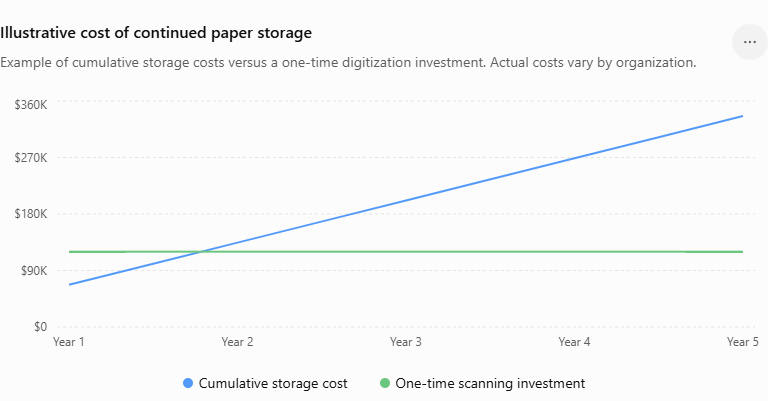
Annual storage alone equals:
800 × $7 × 12 = $67,200 per year
Even without considering retrieval fees, transportation, or employee labor, that’s more than $330,000 over five years.
Now compare that to a one-time document scanning project that permanently digitizes those records.
Instead of paying indefinitely, the investment creates searchable records while significantly reducing ongoing storage costs.
Which Records Should You Scan First?
Not every box needs to be digitized immediately.
Start with records that are:
- Frequently requested
- Required for customer service
- Needed for audits
- Subject to compliance regulations
- Stored long-term
- Occupying expensive office space
Many organizations digitize active records first before addressing long-term archives.
Do You Need to Keep the Paper?
This depends on:
- Regulatory requirements
- Industry standards
- Internal policies
- Legal requirements
- Record type
In many situations, organizations can securely destroy paper after verifying successful digitization and following approved retention policies.
Always consult your legal, compliance, or records management team before disposing of original documents.
What Makes a Successful Records Digitization Project?
The best scanning projects don’t simply create image files.
A modern document conversion project should include:
- High-quality document scanning
- OCR for searchable text
- Indexing and metadata capture
- Quality assurance
- Secure chain of custody
- Delivery into a document management system
- Retention planning
- Optional secure destruction after approval
The goal is making information easier to find, use, and manage.
Frequently Asked Questions
Is it worth scanning archived paper records?
If records are stored long-term, frequently retrieved, or generate recurring storage fees, document scanning often delivers significant operational and financial benefits.
How do I stop paying for document storage?
Start by inventorying your stored records, identifying retention requirements, prioritizing high-value boxes for scanning, and creating a phased digitization plan. Once records are digitized and retention policies permit, many organizations reduce or eliminate offsite storage.
How do I calculate ROI on document scanning?
Compare the one-time cost of scanning against recurring storage fees, retrieval costs, employee labor, office space, and productivity gains. Many organizations recover their investment over time by eliminating ongoing storage expenses.
Can scanned documents replace paper records?
In many cases, yes. Depending on applicable regulations and business requirements, scanned documents can serve as the official business record. Always verify legal and compliance requirements before destroying originals.
Should I digitize every box?
Not necessarily. Many organizations begin with frequently accessed, high-value, or high-cost records before expanding to the rest of their archive.
Stop Paying to Store Information You Can’t Use
Paper storage made sense when filing cabinets and warehouse shelves were the only option.
Today, organizations have a better alternative.
Instead of paying indefinitely to store boxes that rarely leave the warehouse, businesses can transform those records into searchable, secure digital assets that improve productivity, support compliance, and reduce long-term costs.
The question is whether your records are creating value, or simply generating another monthly storage invoice.