
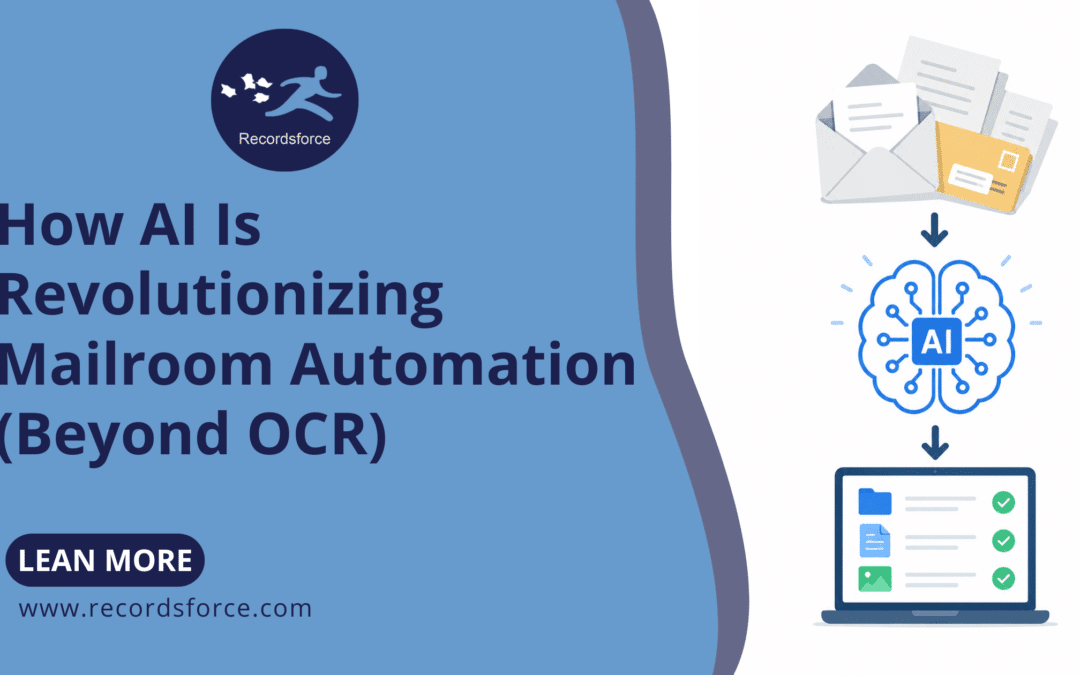
At the MailCom conference in Las Vegas, Recordsforce CEO, Bill Becker, discussed a topic that is quickly reshaping the future of document processing: artificial intelligence and its growing role in modern mailroom automation. During his presentation, he explored how organizations are moving beyond traditional document scanning and OCR toward intelligent systems that can understand, classify, and activate business workflows.
That presentation sparked conversations about what AI actually means for today’s mailroom and why OCR alone is no longer enough.
This article takes a deeper dive into the technologies, capabilities, and business impact behind AI-powered mailroom automation, explaining how organizations are transforming inbound documents into actionable business intelligence.
The Traditional Mailroom Has Reached Its Limits
For decades, organizations viewed the mailroom as a necessary back-office function. Incoming mail was opened, sorted, scanned, indexed, and manually distributed to departments across the business.
The introduction of Optical Character Recognition (OCR) represented a major leap forward by converting paper documents into searchable digital text. Instead of storing paper files, organizations could search electronic documents and reduce manual data entry. But OCR was designed to recognize characters, not understand information.
Current organizations process far more than neatly formatted paper documents. They receive invoices, contracts, claims, legal notices, applications, correspondence, forms, checks, and customer communications arriving through physical mail, email, secure portals, and digital uploads.
Simply converting these documents into searchable text is no longer enough.
Organizations need systems that understand what documents are, why they matter, and what should happen next.
Why Traditional OCR Is No Longer Enough
OCR technology excels at recognizing printed text from scanned images.
It can:
- Convert paper into searchable text
- Improve document storage
- Reduce manual typing
- Support electronic archives
However, OCR alone cannot:
- Understand document meaning
- Interpret business context
- Distinguish between complex document types
- Make routing decisions
- Identify business intent
- Trigger downstream workflows
- Adapt to changing document formats
As document volumes continue growing, relying solely on OCR often leads to bottlenecks, manual review, and inconsistent processing.
AI Adds Intelligence to Document Processing
Think of OCR as teaching a computer to read words. AI teaches it to understand what those words mean.
Modern AI-powered mailroom automation combines OCR with machine learning, natural language processing, and intelligent decision-making to create systems capable of processing documents much like an experienced employee would.
Instead of simply digitizing information, AI can understand, organize, prioritize, and activate business processes.
AI-Powered Classification and Intelligent Document Capture
One of the biggest advances in mailroom automation is AI-driven document classification.
Traditional systems often relied on predefined templates or barcode recognition. Those methods work well for standardized forms but struggle when documents vary in layout or format.
AI analyzes document structure, language, metadata, and contextual patterns to determine exactly what type of document has been received.
For example, AI can automatically distinguish between:
- Invoices
- Insurance claims
- Legal filings
- Medical records
- Contracts
- HR forms
- Customer correspondence
- Financial applications
Once classified, Intelligent Document Capture (IDC) extracts relevant business information such as:
- Customer names
- Policy numbers
- Invoice totals
- Dates
- Account numbers
- Property addresses
- Case numbers
- Vendor information
Instead of manually indexing documents, organizations receive structured data that’s immediately ready for business use.
AI Makes OCR Smarter
OCR remains an essential component of document processing, but AI significantly enhances its effectiveness.
Rather than simply recognizing text, AI helps:
- Correct OCR recognition errors
- Interpret poor scan quality
- Process handwritten information
- Understand complex layouts
- Improve extraction confidence
- Flag exceptions automatically
The combination of OCR and AI dramatically improves accuracy while reducing the amount of manual quality review required.
For organizations processing thousands of documents every day, even small improvements in accuracy can translate into significant operational savings.
From Document Delivery to Business Intelligence
Traditional mailroom automation focused on getting documents from Point A to Point B.
AI shifts the focus from document delivery to operational intelligence.
Rather than simply forwarding documents to employees, AI understands what the document represents and initiates the appropriate business process automatically.
For example:
- An insurance claim can begin claim processing.
- A legal filing can update a case management system.
- A payment notice can trigger accounts receivable workflows.
- A patient referral can enter a healthcare workflow.
- A contract amendment can notify legal teams immediately.
Instead of employees deciding what happens next, AI can recommend, or even automate, the next step.
This dramatically shortens processing times while improving consistency.
AI-Powered Dynamic Business Process Management
Perhaps the most transformative capability is AI’s ability to drive business workflows automatically.
Traditional workflow models typically follow this sequence:
- Document arrives.
- Employee reviews it.
- Employee determines where it belongs.
- Employee starts the workflow.
AI changes that entirely.
Documents arriving through:
- Physical mail
- Secure portals
- Digital forms
- Customer uploads
- Electronic submissions
can automatically:
- Trigger workflows
- Assign work queues
- Prioritize urgent requests
- Escalate exceptions
- Notify stakeholders
- Initiate approvals
- Update enterprise systems
The result is an adaptive business process that responds to incoming information in real time instead of waiting for manual intervention.
Why Human Validation Still Matters
Despite tremendous advances in AI, fully autonomous document processing isn’t appropriate for every organization.
Many businesses must comply with strict regulatory requirements while managing sensitive or high-value information.
Human validation remains important for:
- Regulatory compliance
- Complex exceptions
- Poor-quality documents
- Business rule changes
- Sensitive customer information
- Continuous quality assurance
The most successful organizations are adopting a hybrid model where AI performs the repetitive work while employees focus on reviewing exceptions and higher-value decisions.
Rather than replacing people, AI allows them to spend more time on work that requires judgment and expertise.
The Modern Mailroom Needs a New Playbook
Our business environment today looks very different than it did even a decade ago.
Organizations now operate with:
- Hybrid workforces
- Remote employees
- Real-time customer expectations
- Increasing compliance obligations
- Growing document volumes
- Digital-first business processes
The traditional mailroom simply wasn’t designed for this level of complexity.
It’s a bit like NASCAR pit crews in the 1990s. Back then, speed and coordination alone could win races. Today, elite pit crews rely on real-time telemetry, predictive analytics, automation, and continuous data-driven decision making.
The mailroom is experiencing a similar transformation. Success is no longer determined by how quickly documents can be scanned. It’s determined by how intelligently organizations can transform incoming information into action.
The Future of AI-Driven Mailroom Automation
Artificial intelligence is redefining the role of the mailroom.
What was once a cost center focused on processing paper is becoming an intelligent operational hub capable of orchestrating workflows, improving visibility, accelerating decision-making, and unlocking valuable business insights.
As AI continues to mature, organizations will increasingly use inbound documents to:
- Trigger intelligent workflows
- Generate operational insights
- Power enterprise search
- Improve customer experiences
- Support compliance initiatives
- Enable faster business decisions
- Drive organization-wide automation
The future of mailroom automation is no longer about digitizing documents.
It’s about transforming every inbound document into actionable business intelligence.
Organizations that embrace this shift will be better positioned to improve efficiency, reduce manual work, and create smarter, more connected operations.
At Recordsforce, we’ve seen this evolution firsthand. As organizations move beyond basic scanning and OCR, they’re looking for solutions that combine secure document capture, AI-powered classification, intelligent data extraction, workflow automation, and human quality assurance into one seamless process. That’s the foundation of a modern digital mailroom and it’s where the industry is headed. By helping organizations turn inbound documents into actionable business intelligence, Recordsforce continues to lead the conversation on what’s next for AI-powered mailroom automation.