Digital transformation conversations in healthcare and insurance often focus on AI, analytics, patient portals, or core system upgrades.
But there’s a less glamorous, often overlooked constraint quietly limiting performance:
Document intake.
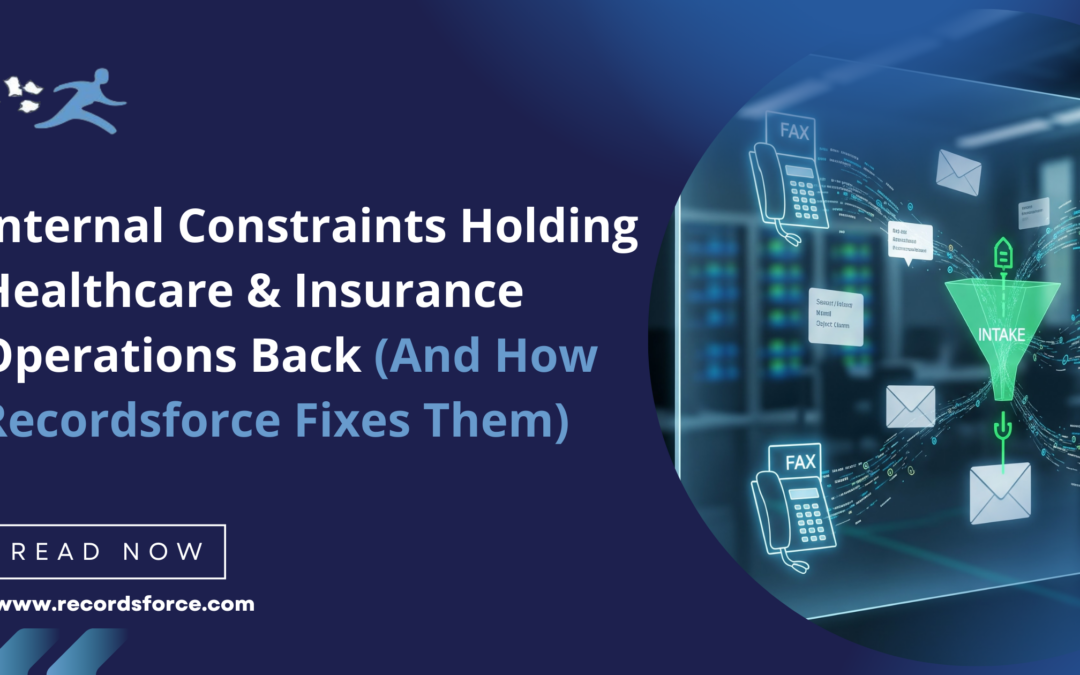
Mail, fax, email attachments, portal uploads, EDI files, payer correspondence, this is the operational starting line for claims, eligibility, revenue cycle, HIM, and compliance workflows.
When intake isn’t modernized, everything downstream slows down.
Let’s break down the most common internal constraints organizations face and how a digital mailroom removes them.
1. Integration Complexity
Healthcare and insurance ecosystems are complex.
Document intake must connect to:
- Claims systems (Facets, QNXT, HealthEdge)
- EMRs like Epic and Cerner
- Revenue cycle platforms
- HIM systems
- Case management tools
- Workflow automation systems
- Data warehouses
Buyers worry about adding “one more system” that creates:
- Another login
- Another silo
- Another integration project
- Another IT lift
Why This Becomes a Bottleneck
When integration feels heavy:
- Projects stall.
- IT teams push it down the priority list.
- Intake modernization gets delayed in favor of more visible digital initiatives.
And yet, intake directly affects claims cycle time, prior authorizations, appeals, and compliance.
How a Digital Mailroom Fixes It
A digital mailroom solution can:
- Integrate directly into your existing systems.
- Route documents and metadata into your workflows.
- Match indexing structures to your current taxonomy.
- Work within your claims, EMR, and rev-cycle architecture.
The goal isn’t to add a system.
The goal is to make intake invisible and automatic.
You keep your core platforms.
We make sure documents enter them correctly, consistently, and immediately.
2. Heavy Change Management
Healthcare organizations are deeply operational and paper habits are ingrained.
Common realities:
- Staff rely on familiar paper workflows.
- Departments route documents informally.
- “This is how we’ve always done it.”
- Intake standards vary by team.
Providers often:
- Forward emails manually.
- Print documents that arrived digitally.
- Physically walk paperwork between departments.
- Rename files inconsistently.
That inconsistency creates:
- Delays
- Lost documents
- Compliance exposure
- Duplicate work
Why Change Feels Hard
Even when leadership wants modernization:
- Staff fear disruption.
- Training takes time.
- Leaders worry about short-term workflow interruptions.
How Recordsforce Makes It Easier
We design intake around your current workflows then standardize them behind the scenes.
Recordsforce’s digital mailroom solution:
- Centralizes intake across locations.
- Applies consistent classification and indexing rules.
- Automates routing to the right team.
- Removes manual handoffs.
Staff don’t have to become document routing experts.
They simply receive:
- The right document
- With the right metadata
- In the right system
- At the right time
Change becomes incremental, not disruptive.
3. The “Back-Office” Perception Problem
Intake automation is often viewed as:
- Operational
- Administrative
- Non-strategic
Meanwhile, executive focus goes to:
- AI initiatives
- Patient experience tools
- Clinical transformation
- Data analytics investments
But here’s the reality:
If intake is delayed, analytics are delayed.
If intake is inconsistent, compliance is exposed.
If intake is manual, cycle time suffers.
Mail and document intake is not “back-office.”
It’s operational infrastructure.
How Recordsforce’s Digital Mailroom Reframes the Conversation
We position intake modernization around measurable business impact:
- Reduced claims cycle time
- Faster prior authorization turnaround
- Lower denial rates
- Improved SLA adherence
- Better audit readiness
- Increased workforce productivity
When intake becomes predictable and visible, executives see:
- Operational velocity
- Risk reduction
- Capacity gains
It’s not about scanning paper.
It’s about protecting revenue and improving outcomes.
4. Dependence on Physical Mail Volumes
Traditional scan-heavy vendors face a long-term challenge:
Mail is evolving.
Organizations now receive documents via:
- Physical mail
- Fax
- Secure portals
- APIs
- Payer-provider exchanges
- EDI feeds
If your intake strategy only handles paper, it’s incomplete.
Modern healthcare operations require omnichannel intake.
How Recordsforce’s Digital Mailroom Solution Future-Proofs Intake
We don’t just scan envelopes.
Recordsforce supports:
- Physical mail digitization
- Fax capture
- Email ingestion
- Portal monitoring
- API-based intake
- Structured data extraction
- Automated routing
We unify intake across channels into a single, standardized workflow.
As volumes shift from paper to digital, your intake strategy evolves with it.
No reinvention required.
Recordsforce Makes It Easy Because It’s Crucial
Document intake isn’t a small operational tweak.
It is the entry point for:
- Claims
- Revenue cycle
- Compliance
- HIM
- Appeals
- Customer service
- Clinical documentation
If the starting line is delayed, every downstream metric suffers.
At Recordsforce, we remove internal constraints by:
- Making integrations seamless
- Reducing change management friction
- Elevating intake to a strategic priority
- Supporting every intake channel, not just mail
- Delivering measurable operational outcomes
We make it easy because intake modernization is not optional.
It is crucial to your business operations.
When documents flow correctly, your entire organization moves faster.