
An Economic Reality CFOs and AP Leaders Can’t Ignore
For many organizations, Accounts Payable feels modern.
You’ve invested in:
- ERP systems
- Automated payment platforms
- Approval workflows
- Financial reporting dashboards
But there’s one operational starting point that often hasn’t been redesigned: How invoices enter the organization.
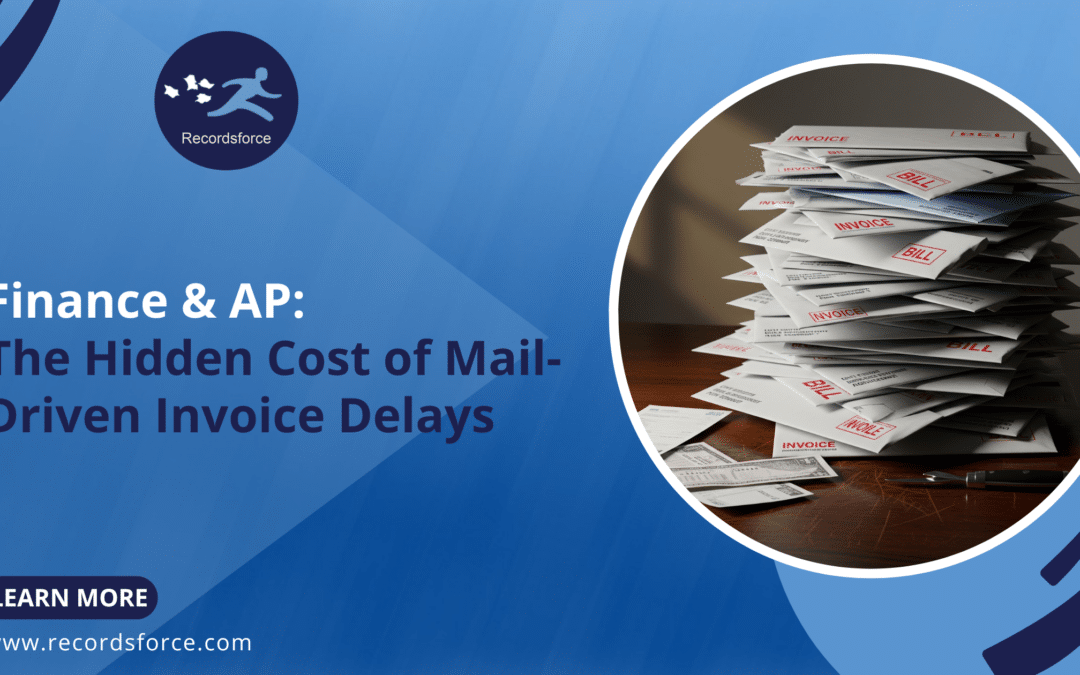
If invoices still arrive via physical mail, shared inboxes, or scattered locations, your AP automation strategy may already be compromised.
The CFO’s Blind Spot: Intake as an Economic Lever
CFOs measure:
- Days Payable Outstanding (DPO)
- Working capital
- Early payment discounts
- Vendor risk
- Payment accuracy
- Internal cost per invoice
- But invoice intake rarely shows up on the dashboard.
And yet, it directly affects every one of those metrics.
If invoices sit:
- In unopened envelopes
- On someone’s desk
- In a shared inbox
- Waiting to be keyed manually
- Forwarded between departments
The Real Cost of Mail-Driven Invoice Delays
Lost Early Payment Discounts
Vendors frequently offer 1–2% discounts for early payment.
If invoice intake is delayed even 3–5 days:
- Approval windows shrink
- Discounts are missed
- Cash optimization opportunities disappear
For large organizations, that adds up to hundreds of thousands, sometimes millions, annually.
Increased Processing Cost Per Invoice
Manual intake increases:
- Data entry time
- Error rates
- Rework
- Internal routing labor
- Exception handling
AP teams spend time:
- Renaming files
- Searching for missing invoices
- Re-entering data already printed on the page
- Asking departments for approvals
The average manual invoice costs significantly more to process than a digitized, indexed, routed invoice.
Mail-driven intake artificially inflates AP labor cost.
Payment Delays & Vendor Friction
When invoices are delayed at intake:
- Payments are delayed
- Vendor inquiries increase
- AP spends time responding to “Where is my payment?”
- Vendor relationships strain
For organizations dependent on key suppliers, that risk compounds.
Strong vendor relationships are financial assets and intake inefficiency weakens them.
Compliance & Audit Exposure
Untracked invoice intake creates:
- Missing documentation
- Approval gaps
- Inconsistent audit trails
- Manual workarounds
During audits, finance teams scramble to reconstruct history.
A controlled intake process provides:
- Time stamps
- Metadata
- Chain of custody
- Workflow documentation
Without it, risk increases quietly in the background.
The AP Leader’s Daily Reality
AP leaders know the operational truth:
Invoices don’t arrive cleanly. They come through:
- Physical mail
- Email attachments
- Vendor portals
- Fax
- Multiple business locations
And before automation even begins, someone must:
- Open
- Sort
- Identify
- Name
- Index
- Enter
- Route
That’s not value-added work, that’s administrative drag.
Economic Framing: Intake Drives Financial Performance
Invoice intake determines:
- How fast approvals begin
- How consistently SLAs are met
- How predictable cash flow timing becomes
- How much manual labor AP requires
- How many exceptions your team must resolve
When intake is slow or inconsistent, every downstream system performs below its potential.
ERP automation can’t compensate for poor intake. Workflow tools can’t fix missing invoices. Finance optimization cannot begin at step three.
It starts at step one.
How Recordsforce Eliminates Invoice Intake Drag
Recordsforce modernizes the starting line.
Instead of simply scanning and uploading invoices, we:
Centralize All Invoice Channels
- Physical mail
- Fax
- Portal feeds
Everything flows into one controlled intake process.
Classify & ePrep Invoices
Before invoices hit your ERP or DMS, we:
- Identify vendor
- Identify document type
- Separate multi-document packets
- Standardize naming conventions
No manual file organization required.
Extract & Index Key Financial Data
We capture critical AP fields such as:
- Vendor name
- Invoice number
- Invoice date
- PO number
- Line-item amounts
- Payment terms
This metadata feeds your financial systems immediately.
Route to the Right Approver Automatically
Invoices don’t sit in shared inboxes.
They are:
- Routed to the correct department
- Assigned to the appropriate approver
- Prioritized based on rules
Approvals begin faster, cycle time shrinks and cash control improves.
What This Means for CFOs
When invoice intake is automated and controlled:
- Early payment discounts increase
- DPO becomes strategic, not reactive
- Cost per invoice decreases
- Vendor satisfaction improves
- Audit confidence strengthens
- AP teams focus on exception management, not clerical sorting
You gain financial predictability, and predictability is leverage.
What This Means for AP Leaders
Your team:
- Stops chasing paper
- Stops renaming files
- Stops manually forwarding invoices
- Stops searching for missing documentation
Instead, they:
- Review
- Approve
- Resolve exceptions
- Manage cash timing strategically
That’s operational maturity.
Scanning Alone Doesn’t Improve Finance Performance
Many vendors digitize invoices, but few transform how invoices enter your financial ecosystem.
If intake remains manual, every automation investment downstream is diluted.
Recordsforce removes intake friction at the source, so Finance and AP can operate with speed, control, and financial precision.
Because in modern finance operations, the starting line matters, and when invoice intake is optimized, the entire balance sheet benefits.